
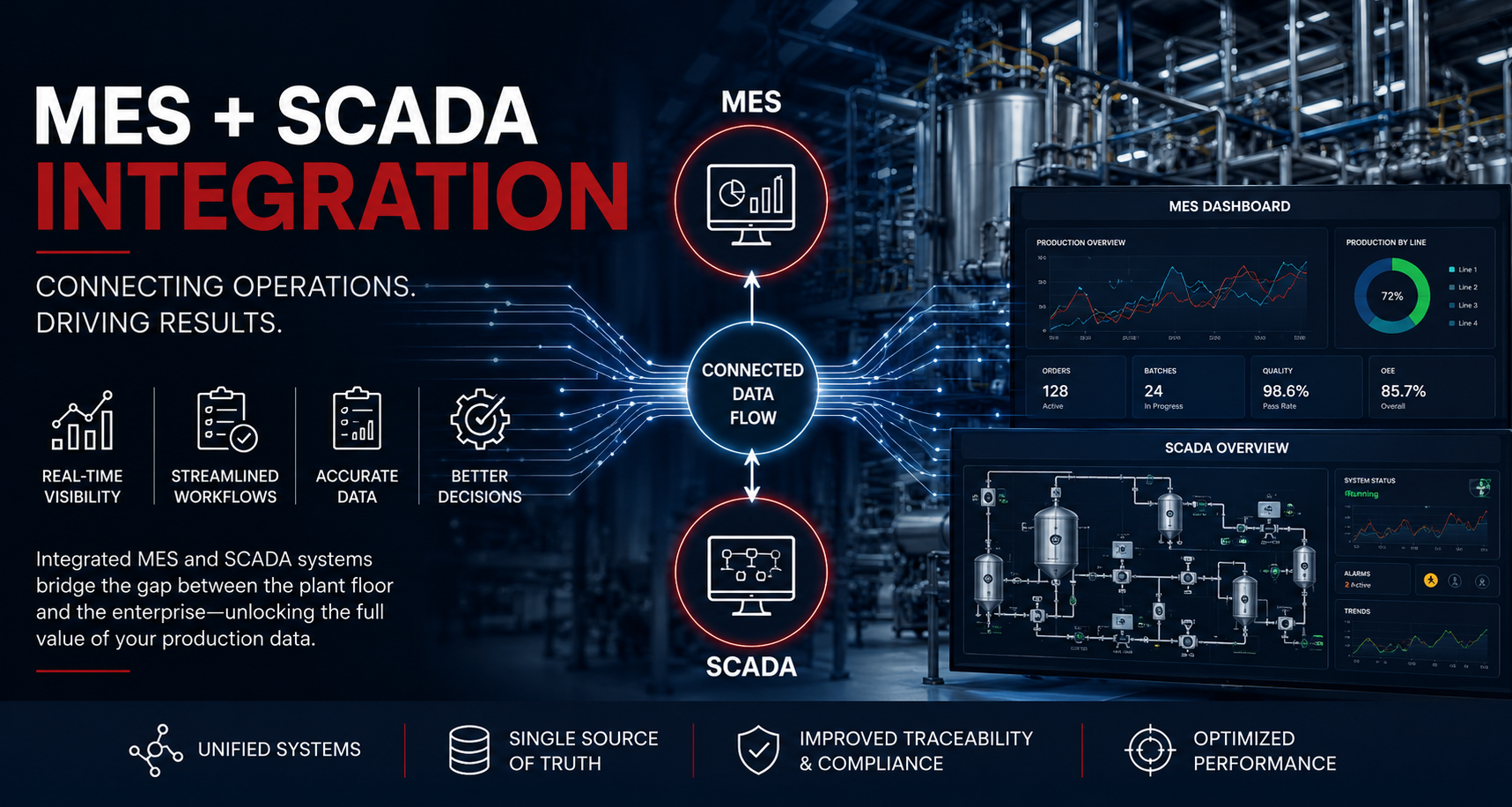
Manufacturers are under constant pressure to improve efficiency, maintain quality, and increase production visibility. Two of the most important technologies supporting these goals are Manufacturing Execution Systems (MES) and SCADA systems.
While each platform serves a distinct purpose, their true value emerges when they work together as an integrated operational environment.
SCADA systems focus primarily on monitoring and controlling industrial processes in real time. They provide operators with visibility into equipment conditions, alarms, process values, and machine status. SCADA platforms are essential for plant-floor operations because they enable immediate interaction with automation systems and production equipment.
MES platforms operate at a higher level within the manufacturing environment. MES systems help manage production workflows, batch execution, scheduling, quality tracking, genealogy, reporting, and operational performance analysis.
When SCADA and MES systems remain disconnected, manufacturers often experience gaps between operational execution and business-level visibility. Operators may see live production conditions, while management lacks accurate production context, traceability, or performance metrics.
Integrated MES and SCADA environments bridge this gap.
SCADA systems provide the real-time production data that MES platforms require to deliver operational intelligence. MES platforms then organize, contextualize, and distribute that information throughout the enterprise.
Key integration benefits include:
- Real-time production tracking
- Automated batch records
- Reduced manual data entry
- Improved traceability
- Better scheduling visibility
- Faster quality investigations
- Enhanced reporting accuracy
In batch manufacturing environments, MES and SCADA integration becomes especially valuable. Recipes, production parameters, material usage, and process execution can all be synchronized automatically across the operation.
Modern integration strategies often leverage:
- ANSI/ISA-88 batch standards
- ANSI/ISA-95 enterprise integration models
- SQL-based reporting systems
- Industrial historians
- Secure Ethernet/IP and industrial communication protocols
Manufacturers implementing integrated MES and SCADA systems gain more than operational efficiency. They create a connected manufacturing ecosystem capable of supporting future digital transformation initiatives, predictive analytics, and advanced automation strategies.
The future of manufacturing relies on systems that not only control processes but also transform production data into actionable operational intelligence.


0 Comments